
Your macros, in grams.
Protein to build, carbs to train, fat to function — in the amounts your body and goal need.
Reviewed July 2026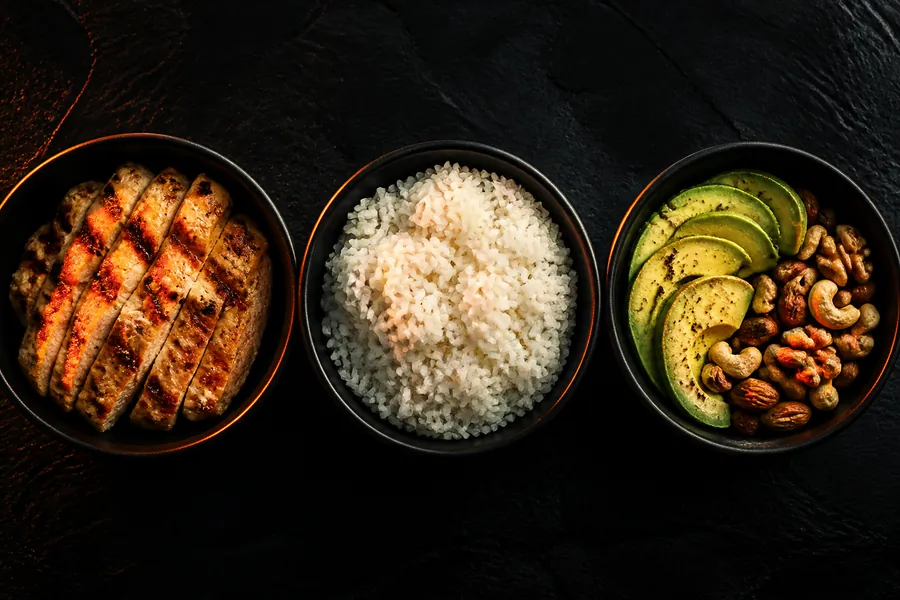
Educational content based on WHO guidelines and scientific literature. Not a substitute for individual medical or nutritional advice.
| Food | Portion | Approximate delivery |
|---|---|---|
| Grilled chicken breast | 100 g | 31 g protein |
| Eggs | 2 units | 12 g protein · 10 g fat |
| Cooked white rice | 100 g | 28 g carbs |
| Cooked beans | 100 g | 14 g carbs · 5 g protein |
| Olive oil | 1 tbsp | 14 g fat |
| Whey protein | 1 scoop (30 g) | 24 g protein |
| Banana | 1 medium | 23 g carbs |
| Peanut butter | 1 tbsp | 8 g fat · 4 g protein |
What macronutrients are and why count grams
Protein, carbohydrate and fat are the three macronutrients — the body’s energy sources and raw material. Each gram of protein or carbs provides 4 kcal; each gram of fat, 9 kcal. Counting calories says how much you eat; counting macros says what you eat — and that difference separates losing "weight" from losing fat while keeping muscle.
Two 2,000 kcal diets can produce completely different bodies: one with 150 g of protein preserves lean mass in a deficit; another with 60 g gives up muscle along with fat. Calorie totals set the scale’s direction — macros set the quality of the result.
How the split is calculated
Protein comes first: 1.8 g per kilo of body weight — inside the 1.6–2.2 g/kg range the literature points to as optimal for building and preserving muscle, in a deficit or a surplus. For 80 kg, that’s 144 g a day.
Fat follows at around 0.9 g per kilo — the floor for hormone production (including testosterone) and absorption of vitamins A, D, E and K. Cutting fat below ~0.6 g/kg to "save calories" tends to backfire.
Whatever calories remain become carbohydrates: training fuel and the most flexible macro of the three. Hard session, more carbs; rest day, fewer — no guilt, no mystery. That hierarchy (calories → protein → fat → carbs) is what the calculator applies automatically.
See also: Calorie Calculator · BMI Calculator
Common mistakes when setting macros
Four traps show up in almost every self-made diet:
- Treating macros as daily law — a ±5–10 g margin on each changes nothing
- Zeroing carbs and watching training collapse by week two
- Forgetting fat is 9 kcal/g — two "invisible" spoons of olive oil are 250 kcal
- Counting incomplete protein sources as if they equaled your daily total
From numbers to ready meals
Knowing the grams is half the journey; the other half is hitting them daily without becoming a kitchen-scale hostage. In ShapeLeague the weekly menu ships already closing your macros — and every photographed plate logs itself, with the AI splitting protein, carbs and fat for you. Substitutions keep macros intact: swap chicken for fish and the plan rebalances instantly.
Sources and further reading
Content based on official guidelines and peer-reviewed literature.
Frequently asked questions
How much protein per day to build muscle?
Evidence points to 1.6–2.2 g per kg of body weight. We use 1.8 g/kg as the sweet spot — beyond that, additional gains are marginal for most people.
What are the ideal macros for fat loss?
There is no magic ratio: first set the calorie deficit, then protein (1.8 g/kg), then fat (0.9 g/kg) — carbs close the remaining calories.
Do carbs at night make you fat?
No. Fat gain or loss is set by daily and weekly calorie totals, not timing. Place carbs where you prefer — including around training, when they help most.
Can I cut fat to lose weight faster?
Below ~0.6 g/kg, hormone production and fat-soluble vitamin absorption start to suffer. Cut calories mostly from carbs and protect a minimum of fat.
Do I need to hit exact macros daily?
A ±5–10 g margin on each macro changes nothing. Priority: total calories first, protein second — carbs and fat are the flexible ones.
Is high protein bad for the kidneys?
In healthy people there is no evidence of renal harm at sports-nutrition ranges (up to ~2.2 g/kg). Anyone with prior kidney disease should adjust with their doctor.
Does whey protein count toward daily protein?
Yes, fully. A typical 30 g scoop delivers about 24 g of complete protein — it works like food, just faster and more convenient.
How do I count macros eating out?
Estimate with visual references (palm ≈ 100 g of animal protein; fist ≈ one carb portion) or photograph the plate in an AI app like ShapeLeague, which does the math for you.
Now turn that number into a plan
The quiz uses these same formulas — plus your real routine — to build training and diet your way. Takes 60 seconds.
Build my free plan →